AI can review your code, documents, and tutorials for inaccuracies. However, you don’t know what source your AI is using when reviewing your content. If it’s pulling from old documentation, it could approve patterns that have since been deprecated, or miss new ones that should be flagged. In this tutorial, you learn how to provide your AI with versioned documentation to fact-check your content. You use Grounded Docs, a local documentation indexer, to index two versions of React’s docs, configure Claude to back each finding with a verbatim quote and source URL, then use those findings to update deprecated code.

Prerequisites

Set up Grounded Docs

Grounded Docs must be installed and the Claude skills must be in place.

The problem with generic AI review

When you ask an AI to review your content, it pulls information from its training data and memory. You have little visibility into the source, so you can’t be sure it’s using accurate or up-to-date information. For example, you could ask Claude:
Hey Claude, review my React tutorial for accuracy.
And Claude confidently replies:
Looks good! The forwardRef pattern is correct — wrapping your component
lets the parent access the child's DOM node. The useRef(null)
initialization is right, and the overall approach follows React best
practices. ✓
How can you be sure that Claude is using the correct version of the React docs? What if it’s pulling from an older version of React that you aren’t using? What if it’s using outdated information from its training data? You have no way to verify the source, so you can’t trust the review. When you provide versioned documentation to your AI, it can fact-check content against specific versions, ensuring accuracy and relevance.

Set up the tutorial file

1

Create a working directory

In your terminal, create a directory for this tutorial and download the React 18 demo tutorial file:
mkdir -p versioned-docs-tutorial
cd versioned-docs-tutorial
curl -O https://raw.githubusercontent.com/cjobermaier/public-resources/main/increase-content-accuracy/react-18-forwardref-tutorial.md
2

Launch Claude Code from this directory

Start Claude Code from inside versioned-docs-tutorial/:
claude
Later commands reference react-18-forwardref-tutorial.md as a relative path, so Claude must be running from this directory.
3

Initialize a Claude session

In the Claude Code terminal, initialize Claude so it’s aware of the tutorial file:
/init

Indexing versioned documentation with Grounded Docs

Grounded Docs is a local documentation indexer. It indexes documentation on your machine, and makes it searchable. So instead of pulling from training data or the live web, Claude queries your local index and you control exactly which version it references. The /docs-manage skill can index documentation. Use the /docs-manage skill to index the React 18.3.1 and React 19.2.0 documentation from react.dev.
1

Index both React versions

Index both React 18.3.1 and React 19.2.0 so you can fact-check against either version. These are the latest patches of React 18 and React 19 at the time of writing — swap in whichever versions your project targets.Run the following command to have Claude index two versions of the React documentation:
/docs-manage Index the following two versions of the React documentation:
- https://18.react.dev/reference/react --version 18.3.1
- https://react.dev/reference/react --version 19.2.0
Claude crawls both sites and stores the content locally. Allow each permission prompt as it runs. If you deny one by mistake, re-run the /docs-manage skill.Indexing time varies depending on the size of the documentation and your hardware.
2

Verify both versions are indexed

Confirm both versions are ready:
Use the /docs-search skill to list the React documentation versions.
The table shows React docs versions 19.2.0 and 18.3.1:
VersionSourcePagesStatus
19.2.0react.dev/reference/react49 pages, 422 docs✅ completed
18.3.118.react.dev/reference/react45 pages, 307 docs✅ completed

Fact-check the tutorial

Claude uses the /docs-search skill to search the indexed docs for supporting or contradicting text and reports each finding with a verbatim quote and source URL. Your exact quotes and verdicts may differ between runs, so you should focus on the structure and the overall conclusions, not exact wording.
You fact check the entire file in this tutorial. You can be granular and fact-check individual claims or sections by including specific keywords in your search query.For example, you could search for “forwardRef accepts a render function with two arguments: props and ref” to fact-check just that claim.
1

Fact-check against React 18.3.1

Run the /docs-search skill to fact-check the tutorial against the React 18.3.1 docs:
Use the /docs-search skill to fact-check
react-18-forwardref-tutorial.md
against the react 18.3.1 documentation.
Claude returns multiple findings with citations from the React 18.3.1 docs. The forwardRef pattern is valid in React 18, so it passes:
Doc path (local): /reference/react/forwardRef
Public URL:       https://18.react.dev/reference/react/forwardRef
Quote:            "forwardRef lets your component expose a DOM node
                  to the parent component with a ref."
Finding:          [DOCS SAY] forwardRef correctly exposes a child's
                  DOM node to a parent. ✅ Accurate
A summary of all the findings looks similar to the following:
ClaimReact 18.3.1
Refs only work on built-in DOM elements by default⚠️ Slightly imprecise — the docs say DOM nodes are private, not that refs fail
React won’t forward a ref to a custom component automatically✅ Confirmed
forwardRef exposes the DOM node to the parent✅ Confirmed
Render function takes props and ref✅ Confirmed
Attach the ref arg to the DOM element you want to expose✅ Confirmed
useRef(null) starts as null until mount✅ Confirmed
2

Fact-check against React 19.2.0

Run the same check against the newer React 19 docs:
Use the /docs-search skill to fact-check
react-18-forwardref-tutorial.md
against the react 19.2.0 documentation.
This time, Claude flags a deprecation in the forwardRef pattern.Notice the Public URL and Doc path point to the location in the React 19.2.0 docs where the deprecation is mentioned. You can click the URL and manually fact-check to confirm the finding:
Doc path (local): /reference/react/forwardRef
Public URL:       https://react.dev/reference/react/forwardRef
Quote:            "In React 19, forwardRef is no longer necessary.
                  Pass ref as a prop instead. forwardRef will be
                  deprecated in a future release."
Finding:          [DOCS SAY] forwardRef is deprecated in React 19.
                  The tutorial teaches it as the required pattern,
                  but the 19.2.0 docs explicitly say it is no
                  longer necessary. ⚠️
Claude identifies that the tutorial is outdated for React 19. The forwardRef pattern is now deprecated, and you need to update the tutorial.A full summary of all the findings will look similar to the following:
Claimvs React 18.3.1vs React 19.2.0
Refs don’t auto-forward to custom components⚠️ Imprecise⚠️ Still true, but fix has changed
Use forwardRef to expose a DOM node✅ Correct⚠️ Deprecated — use ref as a prop instead
forwardRef takes a render fn with props and ref✅ Correct⚠️ Accurate but describes deprecated API
Attach the received ref to the DOM node✅ Correct⚠️ Concept correct, mechanism changed
useRef(null) starts as null until mount✅ Correct✅ Correct

Fix the deprecated code

1

Update the file

Ask Claude to update the file using the React 19 docs as the authoritative source:
Update the tutorial to fix the deprecated `forwardRef` usage,
using the React 19.2.0 docs.
Claude shows you the code it wants to update. You can review the change and accept it.
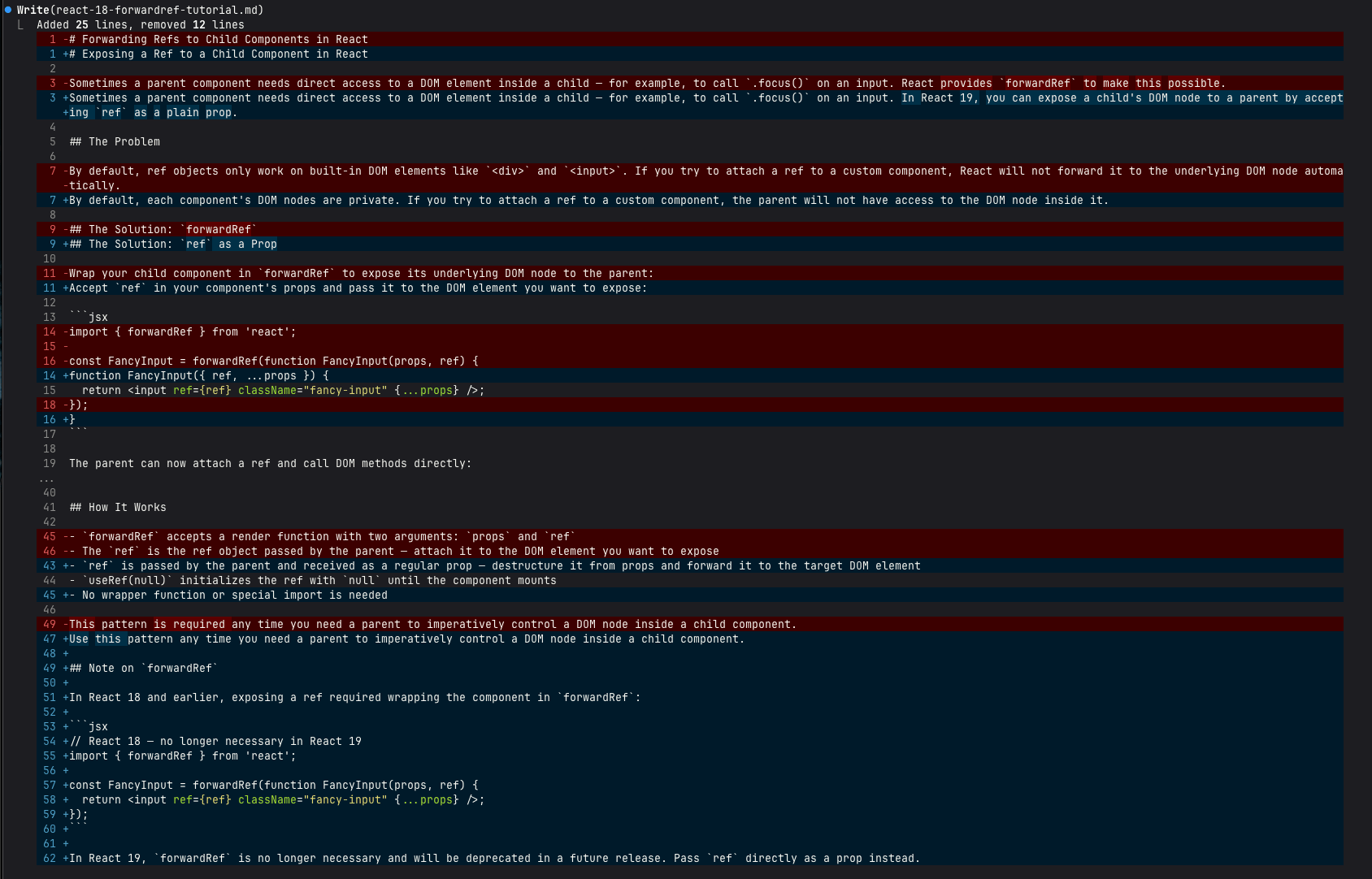
Click on the image to see a larger version of the code diff.
Claude Code diff showing the forwardRef pattern replaced with ref as a propClaude updates the code and gives you a summary of all the changes it made:
LocationBeforeAfter
Title”Forwarding Refs to Child Components in React""Passing Refs to Child Components in React”
Intro”React provides forwardRef to make this possible""you can do this by accepting ref as a regular prop”
Problem framing”ref objects only work on built-in DOM elements""components don’t expose their DOM nodes to parent components” (matches docs exactly)
Solution heading## The Solution: forwardRef## The Solution: Accept ref as a prop
FancyInput componentforwardRef(function FancyInput(props, ref) { ... })function FancyInput({ ref, ...props }) { ... }
import statementimport { forwardRef } from 'react'removed — no longer needed
How It Works bullets”forwardRef accepts a render function with two arguments: props and ref""ref is a built-in prop in React 19 — no wrapper or special API needed”
2

Verify the fix

Re-run the fact-check against React 19.2.0 to confirm the deprecation warning is gone:
Use the /docs-search skill to fact-check
react-18-forwardref-tutorial.md for the deprecated `forwardRef` you just fixed, 
against the react 19.2.0 documentation.
Claude shows the forwardRef claim with a new citation from the React 19.2.0 docs that confirms the fix:
Doc path (local): /reference/react/forwardRef.md
Public URL:       https://react.dev/reference/react/forwardRef.md
Quote:            "In React 19, `forwardRef` is no longer necessary. Pass
                `ref` as a prop instead."
Finding:          [DOCS SAY] ref as a plain prop is the correct React 19
                approach. ✅ Accurate

Claude gives a summary of all the findings again, and the forwardRef deprecation no longer appears:
Claimvs React 19.2.0
Components don’t expose DOM nodes to parents by default
Attaching a ref to a custom component won’t auto-forward it
Add ref to props and pass it to the DOM node
function FancyInput({ ref, ...props }) code example
ref is a built-in prop in React 19, no wrapper needed
useRef(null) starts as null until mount
You used Grounded Docs to index versioned documentation and configured Claude to back each finding with a verbatim quote and source URL. Now your AI reviews cite their sources — and you can trust what they say. Next, try indexing your own framework or library docs and fact-checking one of your own tutorials.
Found an issue with this tutorial? Open a GitHub issue.